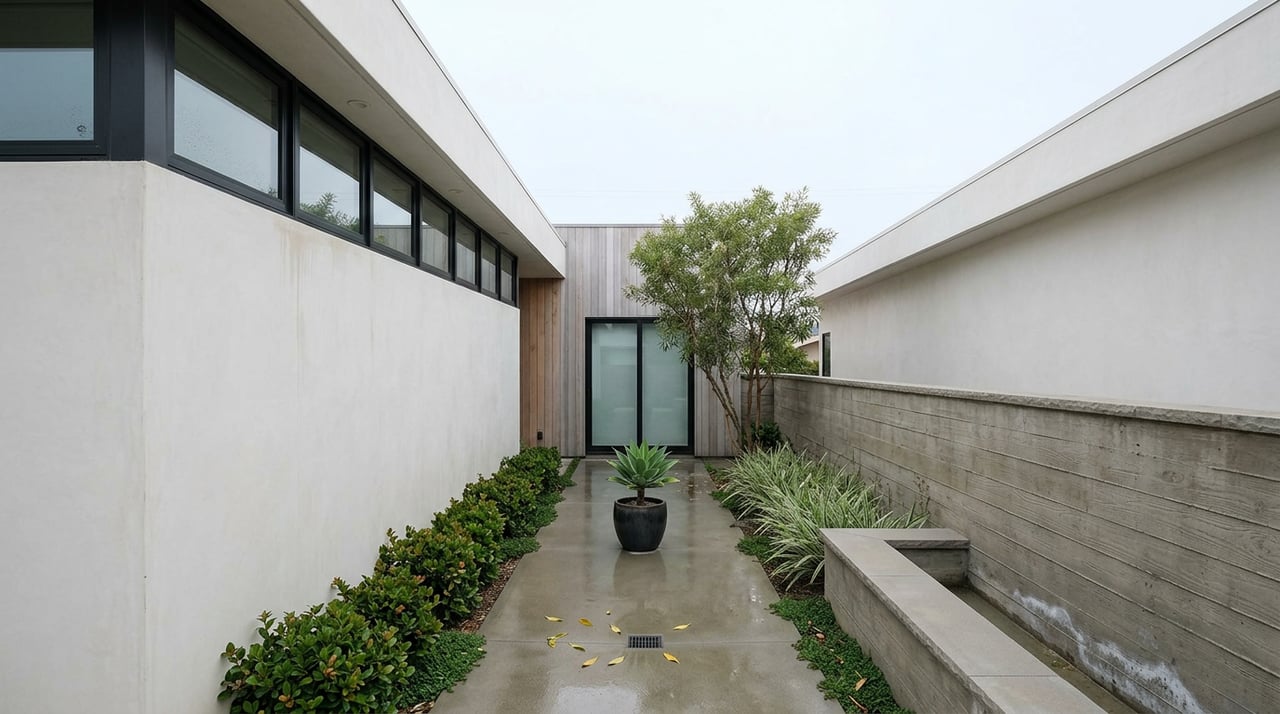
Two listings went up within a few blocks of each other on the Flower Streets this year, both hovering around $3.2 to $3.3 million. One was a well-kept original cottage, roughly 1,300 square feet, on a 2,700-square-foot lot. The other was also a cottage, similar vintage, on a slightly larger 3,500-square-foot lot. Same neighborhood. Same rough era. Same price.
They were not the same purchase.
The first buyer paid for a house: a preserved piece of Corona del Mar's cottage stock, priced for its condition and character. The second buyer paid for the dirt. That home is coming down. What replaces it will be a new duplex, with a front unit and a rear unit. A few blocks over, a newly built front unit of about 1,800 square feet, on the inland side of PCH, listed at $3.5 million, a price close enough to both of the above that a buyer skimming portal comps could mistake all three for the same category of home.
If you're comparing prices on the Flower Streets without knowing which of these three products you're looking at, the comp is worthless before you've even opened the disclosure package.
Why the Same Price Tag Covers Three Products
This isn't random variance. It's zoning, and it's been sitting under the surface of the Village for decades. Moving Evolution has long estimated that a large share of the Corona del Mar Village core carries R-2 zoning. Layer that onto the neighborhood's original subdivision pattern, standard 30-foot-wide by 118-foot-deep parcels running from Acacia to Poppy, and you get a physical template built for exactly this outcome: a front unit facing the street, a rear unit over parking accessed from an alley or shared driveway
The city codifies the distinction directly. Newport Beach routes single-family construction through standard building code and duplexes through a separate section of the municipal code, Section 20.15.080, as laid out in the Corona del Mar Homes Planned Community regulations. That's not a marketing distinction. It's a legal one.
| Product | What you're actually buying | Typical buyer | Signal in the listing |
|---|---|---|---|
| Preserved cottage | A single dwelling, priced for condition and land | Owner-occupant | Original construction date, no mention of "front" or "rear" |
| Legal duplex | Two units, income or multigenerational use | Investor or extended-family buyer | Language like "front unit," "rear unit," or "1/2" in the street address |
| Land-value teardown | The lot, with an existing structure slated for demolition | Builder, developer, or cash buyer | Phrases like "sold at land value" or "blank canvas," or a completed demolition noted in remarks |
Before Buying a Duplex Unit
Before writing an offer on anything described as a duplex unit here, ask your agent about any shared-maintenance history and past repairs.
Why Cash Buyers Dominate the Land-Value Segment
Here's where the three-product problem becomes a financing problem. A lender appraising a single-family cottage is valuing a habitable structure. A lender appraising a listing marketed at land value is being asked to finance dirt, and most residential loan products aren't built for that. The appraisal comes in low relative to the asking price because the asking price was never about the house.
That's a structural reason, not a coincidence, why cash shows up so heavily at this end of the market. In the 30 days leading into mid-June 2026, just over half of Corona del Mar's closed sales involved no financing at all. Builders and small developers buying teardown lots pay cash because waiting on a conventional appraisal to catch up to a land-value price tag isn't a realistic path to close. If you're an owner-occupant buyer competing for a property you assume is a livable cottage, and it turns out to be priced as a demolition candidate, you may find yourself outbid by a cash offer that was never competing on the same terms you thought you were negotiating.
What the Median Actually Tells You
Corona del Mar's 92625 zip code carried a median list price of $4.44 million as of August 2026, with homes spending a median of 109 days on market, according to portal-reported data for that month. That number blends preserved cottages, legal duplexes, land-value teardowns, and everything in Cameo Shores and Spyglass Hill on top of it. Treating it as a benchmark for a specific Flower Streets parcel tells you almost nothing about what that parcel actually is.
Before you anchor to any comp on the Flower Streets, ask one question first: is this price paying for a house, an income stream, or a hole in the ground where a house used to be?
Pricing precision matters more than the headline number suggests. In the market data reported through mid-June 2026, homes that went under contract in fewer than 15 days sold for an average of 100.2 percent of list price, while homes that sat for more than 30 days averaged 94 percent of list. That gap underscores why it matters to distinguish the product being priced: a duplex, a teardown lot, and a move-in-ready cottage are not directly comparable.
Before You Write an Offer
If you're comparing anything on the Flower Streets, confirm these before you anchor to a number:
- Parcel count. Ask your agent about the parcel count before comparing the property.
- Front or rear. If the listing mentions either term, confirm what the listing covers.
- Demolition status. Check the remarks for land-value language or a completed teardown. Pull the permit history if it isn't disclosed upfront.
- Financing path. Confirm with your lender early whether the specific product you're bidding on, cottage, duplex unit, or land, will appraise the way you expect.
A Few Questions Worth Asking Directly
How do I know if a listing is really priced for land value? Watch the remarks for phrases indicating the structure will be or has been demolished, and pull the permit history. A listing priced meaningfully below what comparable livable square footage would command is often signaling exactly that.
If you're weighing a purchase on the Flower Streets, or pricing a listing there, the difference between these three products is the whole conversation, not a footnote. bouHAUS works this stretch of Corona del Mar block by block, and can walk you through what a specific parcel is actually built to become before you commit to a number.
This article is general information, not legal, tax or financial advice. Consult a qualified professional about your situation.